

- Realism
- Regionalism
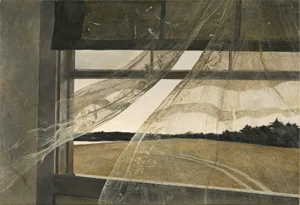
At first glance, you might just see a dusty, old window. And you wouldn't be entirely wrong. The scene was born on a sweltering August day in 1947 when the artist, desperate for a breeze in a stuffy Maine attic, pried open a window that had been shut for ages. What happened next, he said, made his "hair stand on end": a gust of wind blew in, animating the tattered, delicate curtains so that the crocheted birds on them seemed to take flight. This isn't just a painting of a window; it's a portrait, though you won't see a face. Wyeth considered it a symbolic representation of Christina Olson, a neighbor who suffered from a degenerative muscle disorder. The composition is deceptively simple, a hallmark of an artist who pared subjects down to their "essence." The sturdy window frame can be seen as Christina's resilient spirit, while the decaying, wind-tossed curtains symbolize her physical fragility. Those little crocheted birds, suddenly alive, suggest a longing for freedom from a body that kept her grounded. Using tempera, a medium that allows for meticulous detail, Wyeth freezes this fleeting moment of air and light. The painting is a masterclass in making a profound statement with almost nothing in the frame. It explores the connection between a lonely interior space and the vast outside world, all sparked by a simple gust of sea air.
How did ArtBot do? Should we ask him to regenerate the information?
The information is correct?