

- American Realism
- Social realism
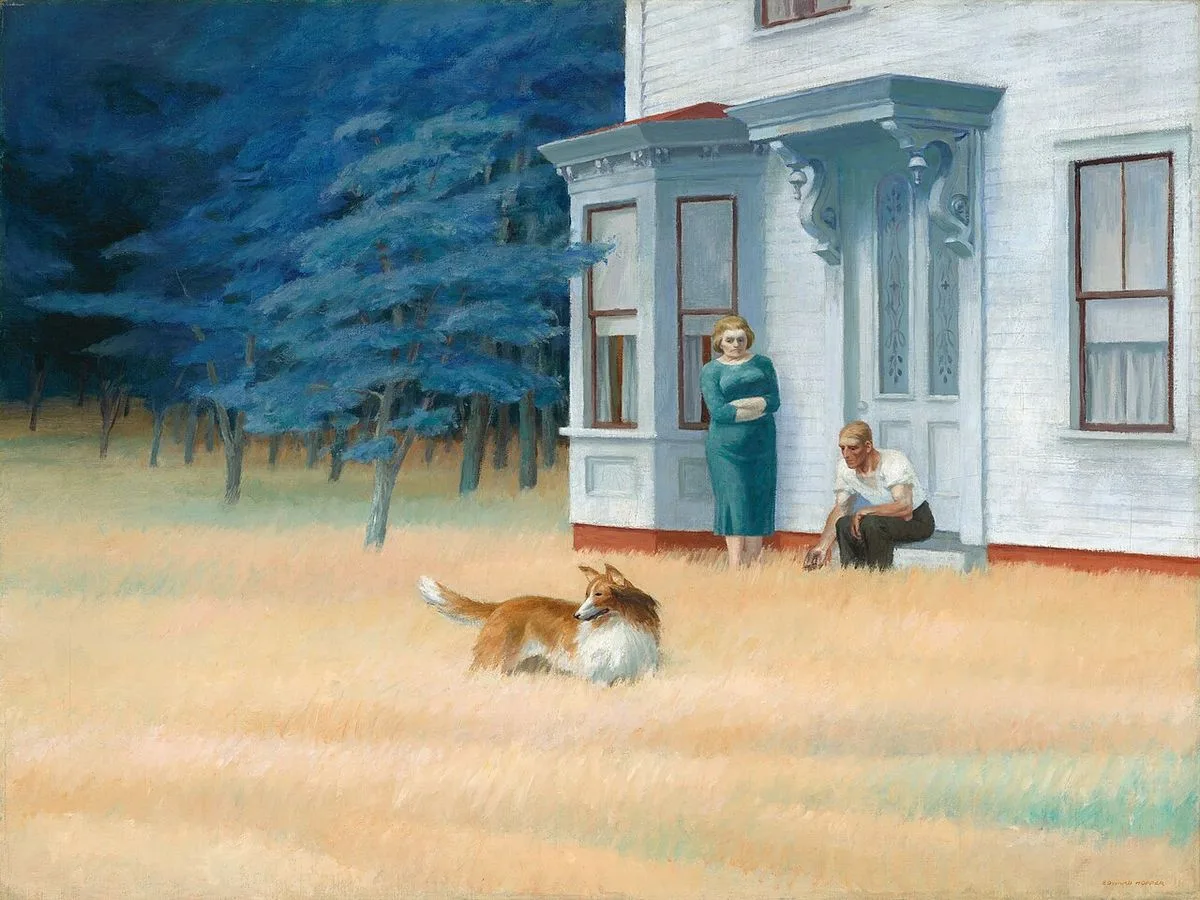
So, you think you're looking at a peaceful seaside scene? Take a closer gander at "Cape Cod Evening." It's less about quiet contemplation and more about a full-blown existential crisis playing out in the tall grass. The composition is deceptively simple: a house, some trees, a man, a woman, and a dog. Yet, the scene is humming with a quiet dread. Three-quarters of the canvas is devoted to an untamed landscape of dry, blowing grass and a dark, encroaching grove of locust trees. Nature isn't just a backdrop here; it's practically reclaiming the yard from a couple who seem too lost in their own worlds to notice. Speaking of our couple, they're a classic example of being alone together. The woman stands with her arms defensively crossed, while the man seems to be trying, and failing, to get the dog's attention. They are physically close but psychologically miles apart, a common theme for our artist who had a knack for depicting dysfunctional relationships. The only creature that seems to have its act together is the collie, who is completely captivated by something unseen in the woods—a sound that has its full, undivided attention. Finished in 1939, some have interpreted the painting's ominous mood as a foreshadowing of World War II. The painting itself wasn't a spontaneous snapshot of a real place, but rather a carefully stitched-together vision from various sketches and memories of the Cape Cod area. The original title was almost "Whippoorwill," after the bird whose call has so entranced the dog. Perhaps it's calling out a warning, or maybe it's just a reminder that even in a quiet evening, someone—or something—is always paying attention.
How did ArtBot do? Should we ask him to regenerate the information?
The information is correct?