

- Political art
- Figurative art
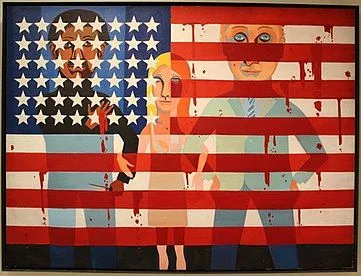
Let's be honest, a bleeding flag isn't exactly a subtle image. Painted in 1967, this work takes the star-spangled banner and turns it into a crime scene. The flag's red stripes don't just represent hardiness and valor; here, they're actively dripping blood, suggesting that the very fabric of the nation is wounded. This was, after all, created toward the end of the Civil Rights Movement, a period marked by violence and racial conflict. Caught within the flag's design are three figures: a Black man, a white woman, and a white man, linked arm-in-arm in a twisted display of unity. The white man stands confidently, hands on his hips, while the woman in the middle serves as a literal link between the two men. Meanwhile, the Black man holds a knife and presses his other hand to a chest wound, a gesture that cleverly mimics the Pledge of Allegiance while simultaneously trying to stop the bleeding. It’s a powerful, uncomfortable image that questions patriotism and the so-called American dream. The composition essentially imprisons the figures behind the bars of the flag, turning a symbol of freedom into one of constraint. The bold, graphic style ensures you can't just glance away; it forces a reaction. While some artists were painting pretty, abstract flags, Ringgold decided to show the "hell that had broken out in the States," making for a much more interesting, if unsettling, conversation starter.
How did ArtBot do? Should we ask him to regenerate the information?
The information is correct?