

- Abstract Expressionism
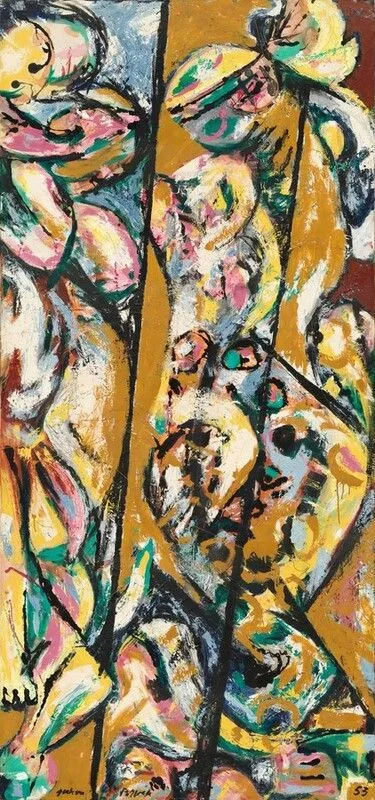
So, you're looking at "Ritual" and thinking, "What, exactly, am I supposed to be seeing here?" That’s a fair question. Created in 1953, this painting comes from a time when the artist was pivoting from his famous "drip" technique back to using good old-fashioned brushes. But don't expect a straightforward picture. The composition is a frenzy of energetic, abstract forms that seem to leap across the canvas. The whole scene is dramatically divided into three vertical sections by two stark black lines. It’s a bit like looking at a chaotic triptych, but without any discernible saints or sinners. Or are there? Some of his works from this period hinted at a return to figures, so feel free to play a game of "what's that shape?" Are they dancers in some ecstatic ceremony? Mythical creatures? Or just beautifully rendered chaos? The title "Ritual" is your biggest clue, and it's not a subtle one. The artist was deeply interested in the ceremonial art of Native American sand painters and the psychological theories of Carl Jung, with its focus on universal archetypes. His very method of painting was often described as a ritualistic dance, a shaman-like performance with the canvas laid out on the floor. Think of this painting less as a picture of a ritual and more as the ritual itself, captured in oil and canvas. It's a snapshot of the artist's own energetic, almost frantic, creative process. So, what you're seeing isn't just a collection of shapes and colors; it's the aftermath of an artistic rite. Whether it was a sacred ceremony or just a really intense day at the studio is up for you to decide.
How did ArtBot do? Should we ask him to regenerate the information?
The information is correct?