

- Northern Renaissance
- Early Netherlandish
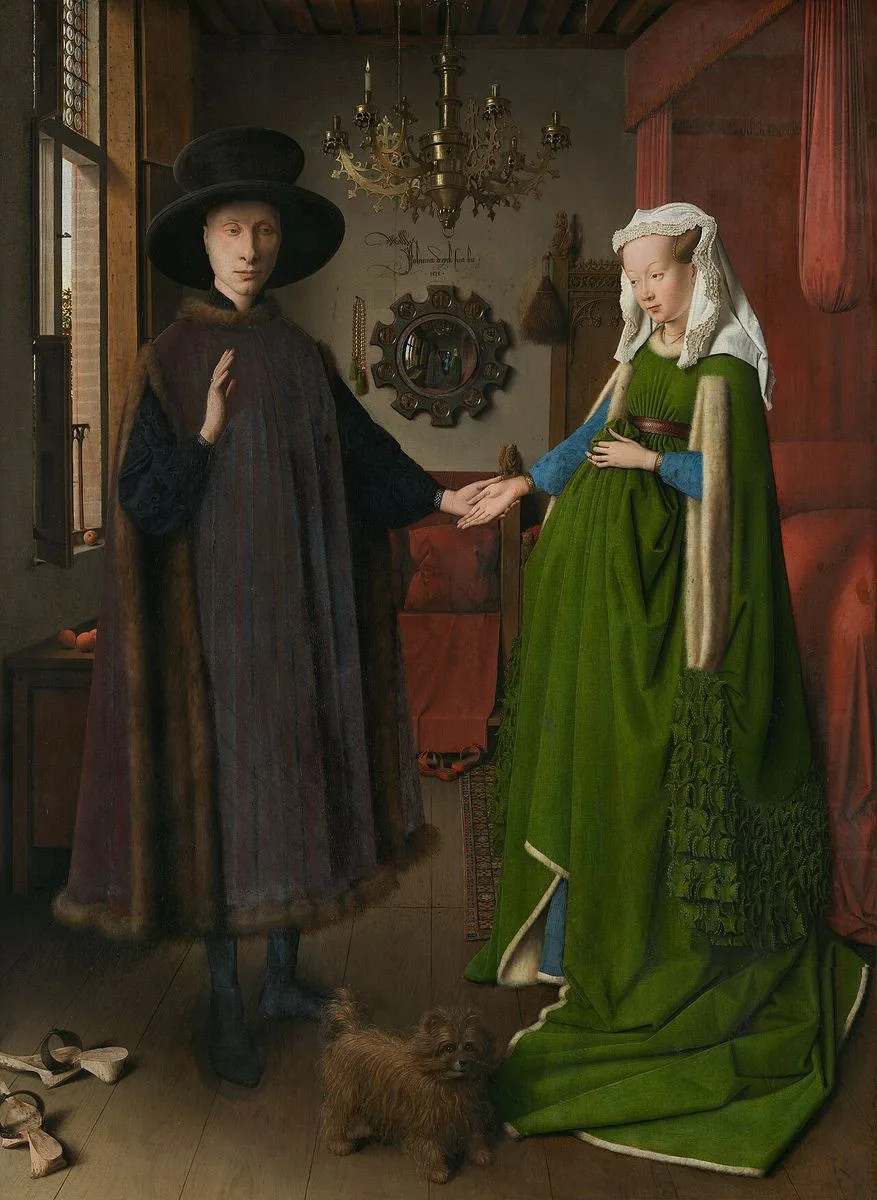
So, you think you're looking at a straightforward portrait of a well-to-do couple? Think again. This painting is less of a simple portrait and more of a 15th-century puzzle box, dripping with symbolism and historical tea. First off, let's address the woman in the room. No, she's not pregnant. That's just a whole lot of very expensive fabric bunched up to show off just how wealthy her husband, a merchant, really was. Speaking of wealth, those oranges casually sitting by the window were a luxury item in Bruges and a subtle flex of their financial status. The composition is a masterclass in showing off. Everything from the elaborate chandelier to the oriental rug screams "we have money." But the real showstopper is the convex mirror on the back wall. If you squint, you can see the reflection of two other figures in the doorway. One is likely the artist himself, who cheekily signed the wall above with "Jan van Eyck was here 1434," basically the earliest known photobomb. Historically, the purpose of this painting is hotly debated. For a long time, it was believed to be a wedding certificate on canvas. More recent theories, however, suggest it might be a memorial portrait. Some clues for this somber interpretation include the single lit candle on the man's side of the chandelier, while the one above the woman is extinguished. Even the cute little dog at their feet could be a symbol of fidelity or a guide to the afterlife, often seen on women's tombs. So, is it a celebration of marriage or a tribute to a deceased wife? The artist isn't telling, and that's half the fun.
How did ArtBot do? Should we ask him to regenerate the information?
The information is correct?