

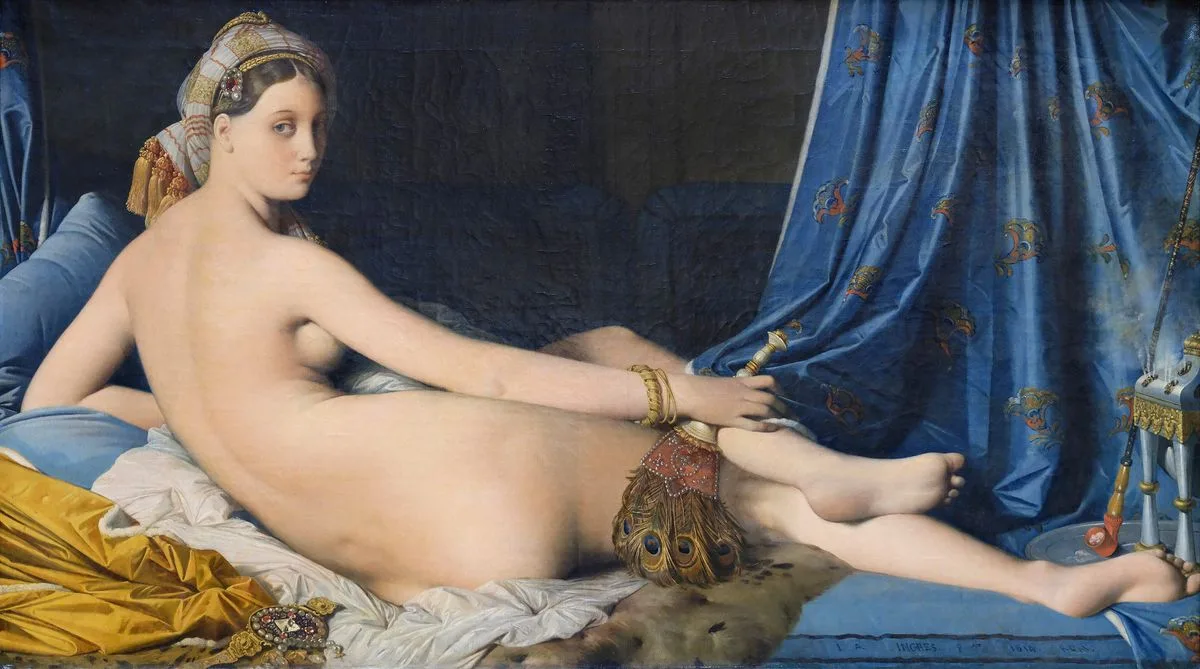
- Neoclassicism
- Romanticism
- Orientalism
Let's be honest, the woman in "Grande Odalisque" has a bad case of too many vertebrae. When this painting first appeared at the Paris Salon in 1819, critics were quick to point out that her spine was impossibly long and her limbs were a bit wonky. One critic even quipped that the work had "neither bones nor muscle, neither blood, nor life." But this anatomical creativity was entirely intentional. The artist wasn't going for realism; he was aiming for a sinuous, sensual line to create an idealized and, let's face it, fantastical vision of a concubine. The term "odalisque" comes from the Turkish for a chambermaid in a harem, and the whole scene is a European fantasy of the "exotic" East. Notice the peacock feather fan, the turban, and the hookah in the corner—all props to set a scene of languid indulgence. This was a popular theme known as Orientalism, and it's worth noting the artist had never actually traveled to the places he was depicting. Commissioned in 1814 by Napoleon Bonaparte's sister, Caroline Murat, the Queen of Naples, the painting cleverly blends a cool, Neoclassical finish with a burgeoning Romantic subject matter. The result is a figure that is both alluring and strangely detached, a perfect embodiment of an imagined, unattainable beauty. She may have a freakishly long back, but she certainly makes an impression.
How did ArtBot do? Should we ask him to regenerate the information?
The information is correct?