

- Post-Impressionism
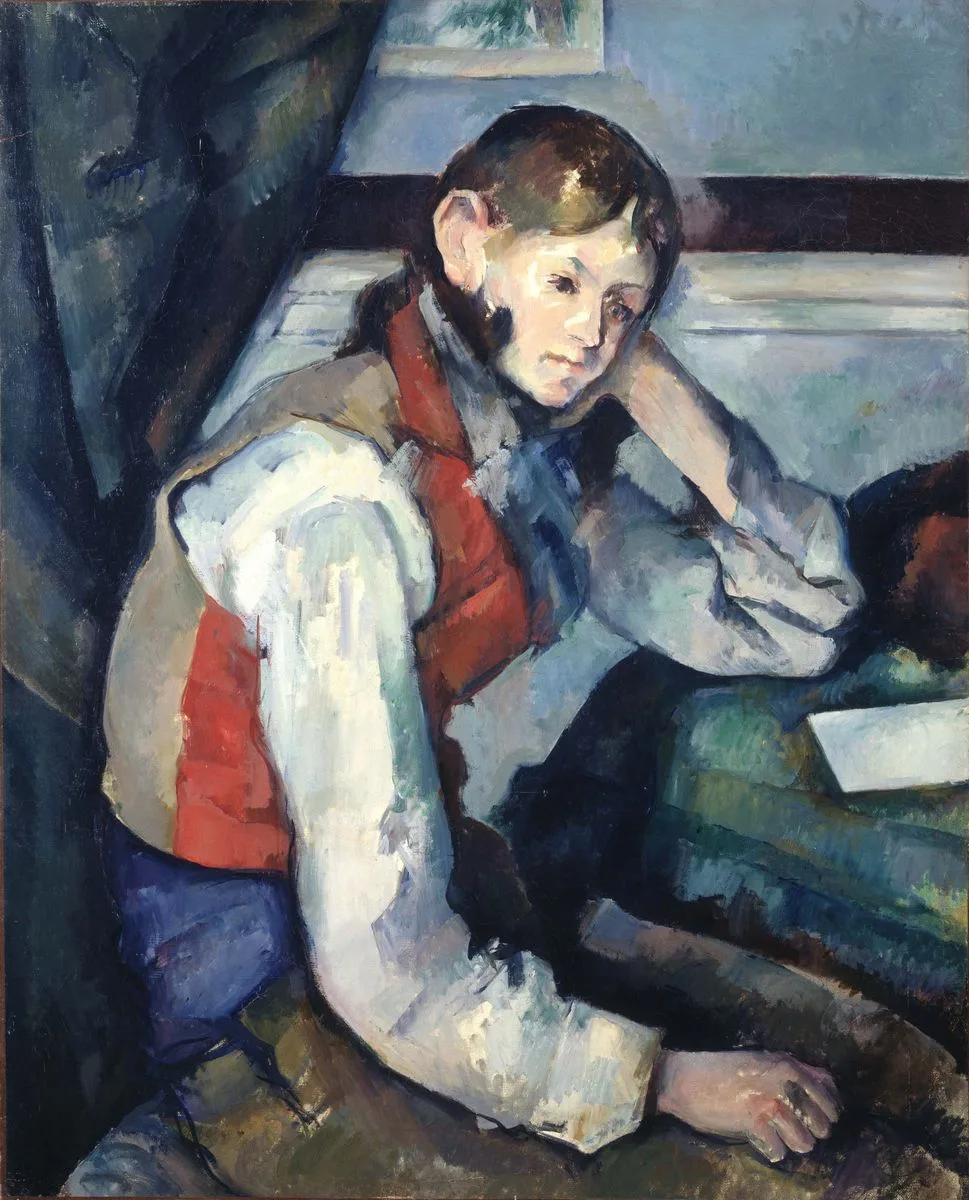
Meet the original sad boy, a young Italian model named Michelangelo di Rosa, who looks about as thrilled to be there as you are at a Monday morning meeting. Painted between 1888 and 1890, this is just one of four portraits Cézanne made of this model, apparently determined to study the relationship between a figure and the space around him. The composition is a carefully orchestrated affair of intersecting diagonals, from the boy's tilted back to the sweeping green curtain. Notice the rhythmic play between curves and straight lines; the drapes are straight on the left and curved on the right, while the boy's body is bent on the left and more rigid on the right. For the sake of this compositional balance, Cézanne even gifted the youth an unnaturally long right arm. The whole scene is a strikingly modern arrangement of color blocks—red, grey, brown, and blue—that create a sense of harmony. Dressed in traditional Italian attire, the boy strikes a pose that recalls aristocratic 16th-century portraits, yet his slouch gives off a vibe of melancholy and passivity. This isn't just a portrait; it's a mood. The heavy drapes seem to envelop him, and even the vibrant red vest feels more cool and oppressive than cheerful. As if the boy’s existential gloom wasn’t dramatic enough, the painting itself had a brush with the dramatic. It was stolen in a brazen 2008 heist and was missing for four years before being recovered in Serbia. Talk about a troubled inner life.
How did ArtBot do? Should we ask him to regenerate the information?
The information is correct?