

- High Renaissance
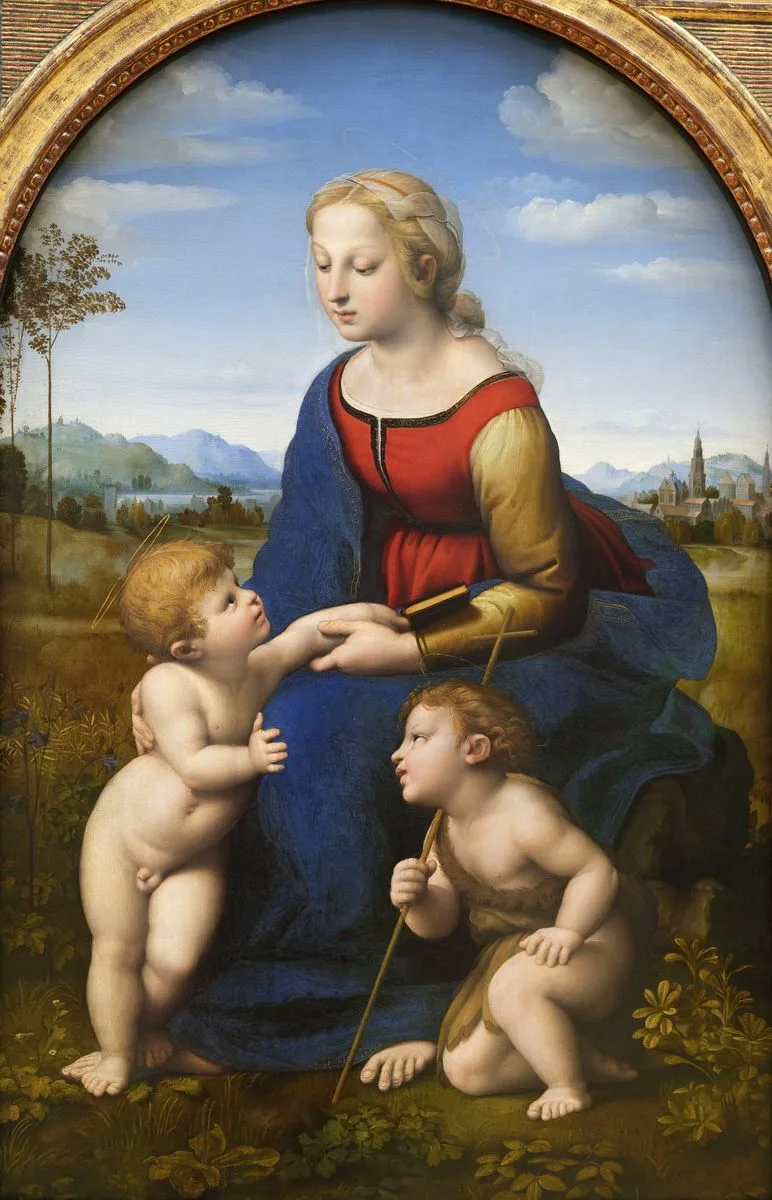
Don't let the serene garden picnic vibe fool you; this painting is loaded with some surprisingly grim foreshadowing. The scene, dubbed "The Beautiful Gardener," presents a tranquil moment between the Virgin Mary, a young Jesus, and his cousin, John the Baptist. Notice how perfectly everyone is arranged? That's the classic pyramid composition favored during the High Renaissance, with Mary's head forming the peak of a neat triangle. It’s a trick to make the whole thing feel stable and harmonious, a carefully constructed illusion of casual grace. The soft, hazy atmosphere is another borrowed trick of the trade, a technique called *sfumato*. But let's get to the juicy part: the symbolism. That book in Mary's hand isn't light reading; it's believed to contain prophecies of Christ's death. The plants scattered about aren't just pretty weeds, either. The violets signify Mary's humility, and the columbines hint at Christ's future sacrifice. Even Mary's wardrobe is part of the story: her red dress symbolizes the Passion of Christ, while her blue cloak represents the Church. Young John the Baptist kneels with his reed cross, another not-so-subtle nod to the crucifixion. For a little historical gossip, the original artist actually left town before this piece was complete. Another painter, Ridolfo del Ghirlandaio, had to step in to finish Mary's blue robe. The painting was commissioned by a Sienese nobleman around 1507, but it eventually made its way into the hands of King Francis I of France, becoming so popular that it spawned numerous copies.
How did ArtBot do? Should we ask him to regenerate the information?
The information is correct?