

- Baroque
- Dutch Golden Age
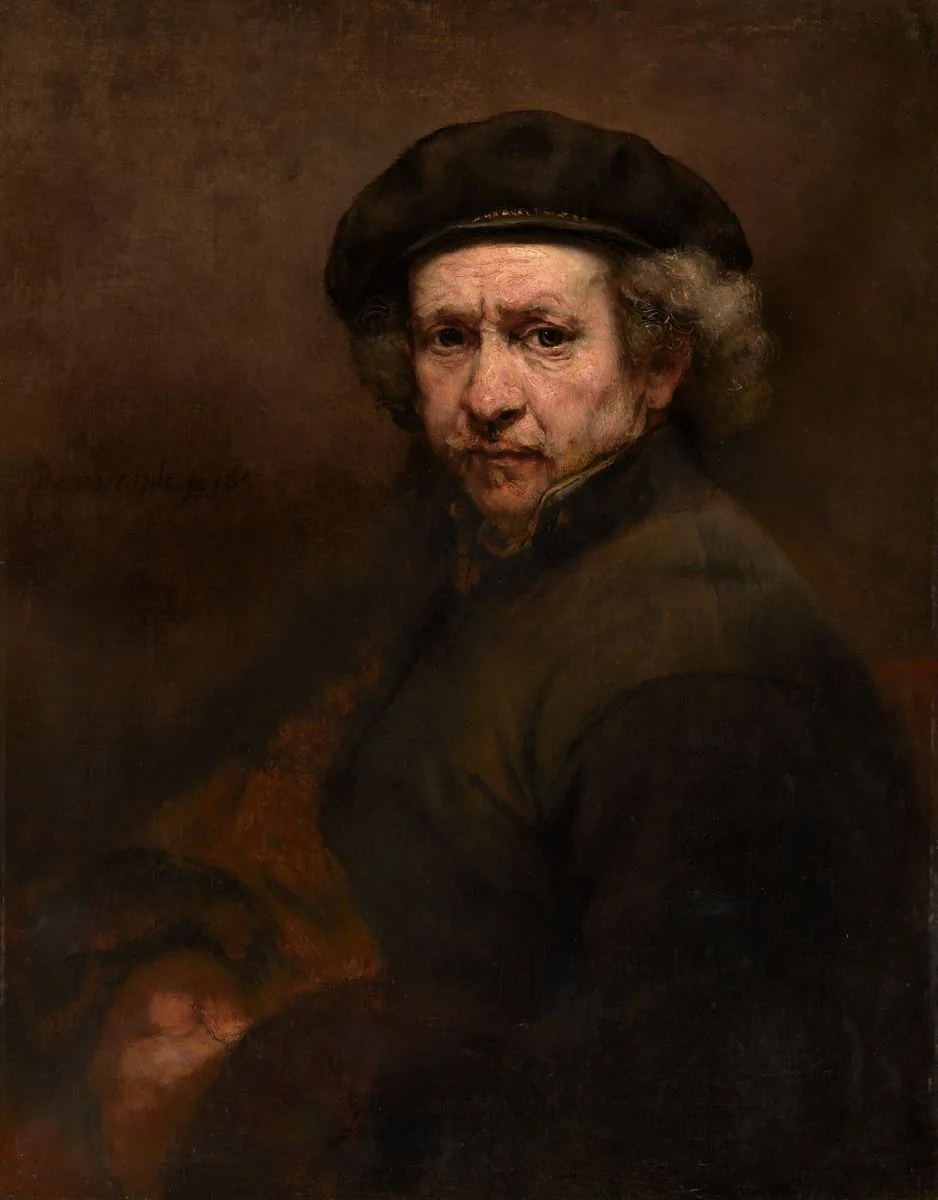
Let's be honest, most of us at this age would be using a filter. Not this guy. He confronts his own weathered face with an unflinching gaze, practically daring you to find a flaw in his technique, even as time picks apart his features. He stands with a hand on his hip, a pose of confrontational confidence, holding the tools of his trade like a king holds a scepter. This isn't one of his earlier works where he's playing dress-up; here, he’s simply a painter in his studio, clad in a fur-lined tabard and a simple white cap. Now, about those two giant circles on the wall behind him. What’s their deal? Art historians have been debating this for ages. Are they symbols of perfection, maybe a nod to the story of the Italian master Giotto, who could supposedly draw a perfect freehand circle? Perhaps they represent theory and practice, or even a map of the world's hemispheres. Or maybe, just maybe, he felt the background looked a bit empty and thought, "You know what this needs? Some enigmatic circles." The painting itself has a fascinatingly "unfinished" quality. While his face is rendered with intense scrutiny, his hands and the fur on his robe are painted with a rapid, almost blurry, energy. X-rays reveal he originally painted himself in the act of painting, but then changed it, deciding a direct, challenging stare was more powerful. It’s a bold move, leaving parts of the canvas seemingly unresolved, a final statement from a master who knew the rules so well he could break them with style.
How did ArtBot do? Should we ask him to regenerate the information?
The information is correct?