

- Surrealism
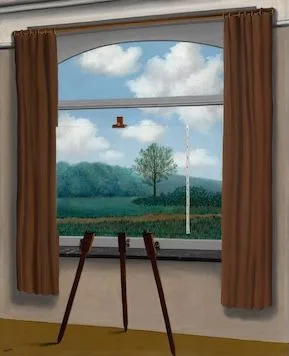
At first glance, René Magritte's 'The Human Condition' from 1933 looks like a perfectly pleasant, if slightly dull, room with a view. But don't get comfortable; you're walking into a philosophical trap, and Magritte is the one who set it. The composition is deceptively simple: an easel stands inside a room, squarely in front of a window. On that easel rests a canvas that appears to perfectly capture the portion of the landscape it hides. The painted scenery aligns seamlessly with the "real" scenery outside, creating a slick illusion. It feels like you’re looking right through the canvas. But hold on. The longer you stare, the more unsettling it becomes. That "real" landscape outside? It’s also just paint on canvas—the one you're looking at. Magritte has cheekily placed a painting within his painting to mess with your head. The artwork isn't just hiding the view; it's presenting an image *of* the view, making you question the difference. With its high-falutin' title, the painting suggests this is everyone's problem, not just the art viewer's. It implies we never get unmediated access to reality; we only ever experience a mental picture of it. We think we’re seeing the world "out there," but we're always stuck with the representation "in here." So, is the painting on the easel a window or a mirror? Magritte’s not telling, and that’s the entire point.
How did ArtBot do? Should we ask him to regenerate the information?
The information is correct?