

- Abstract art
- Expressionism
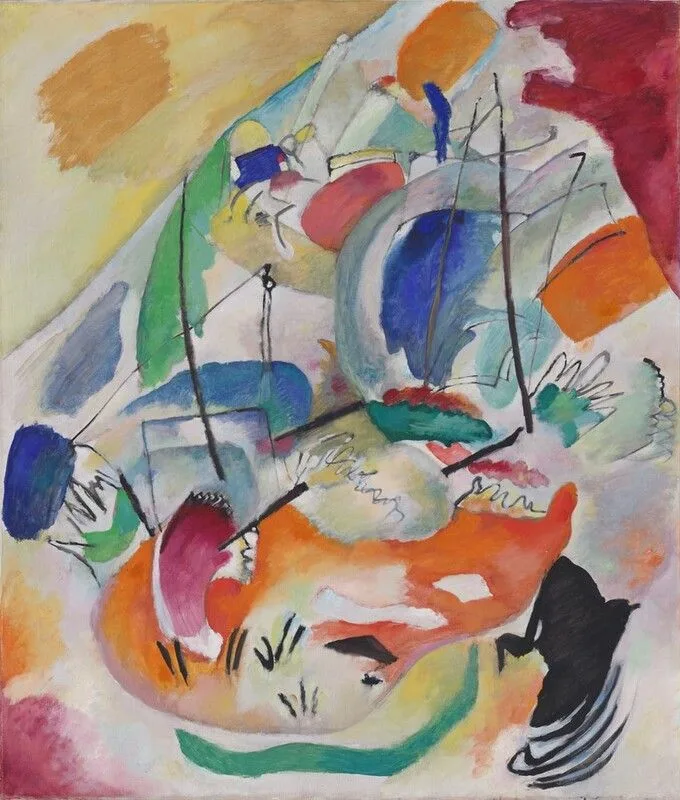
At first glance, "Improvisation 31 (Sea Battle)" might look like a glorious mess, a riot of color and frantic lines. And you wouldn't be entirely wrong. Painted in 1913, on the cusp of major world upheaval, it’s not exactly a serene seascape. If you squint, you can just make out the supposed subject: two tall ships, suggested by thin black masts, blasting away at each other with cannons. It’s less a depiction of a naval battle and more the *feeling* of one—the chaos, the excitement, and the furious motion all splashed onto a canvas. This painting is a prime example of the artist’s "Improvisation" series, which were meant to be spontaneous, unconscious expressions. While the title gives us a nudge, the real story is in the abstraction. Kandinsky wasn't interested in painting a boat; he wanted to paint the *idea* of conflict. The battle depicted is less about a specific war and more about a "spiritual" struggle. He strongly believed humanity was on the verge of a new spiritual era and that art could help sever our attachment to the material world. So, this chaotic scene is actually a metaphor for the internal and external conflicts of his time. Compositionally, the action is cleverly contained within two strong diagonal lines, creating a rising central triangle that gives a strangely heroic vibe to the violence. The colors aren't just for show; they bounce and balloon across the center, with ominous smudges at the bottom right that could be paint, or perhaps something more visceral. Kandinsky, who may have had synesthesia, theorized that colors corresponded to specific emotions and musical sounds, wanting the viewer to experience a painting like a musical score. Think of the shrill trumpet of yellow and the deep cello of dark blue, all clashing in a visual symphony. It’s a calculated chaos, designed to give your soul a little shake-up.
How did ArtBot do? Should we ask him to regenerate the information?
The information is correct?